Lectures
Mechanics I (PHYS3100), Spring 2026
Description
This course covers the following topics: Newton’s laws of motion applied to mass points, systems of particles, and rigid bodies, as well as a comprehensive introduction to Lagrangian and Hamiltonian mechanics. The course is a theoretical treatment of classical mechanics, useful in its own right for treating complex dynamical problems, as well as essential to
understanding the foundations of quantum mechanics and statistical physics.
Advanced Undergraduate Laboratory (PHYS2501W), Fall 2025 and 2026
Description
The goal of this course is to expose students to the practical skills required of scientists working in any field, introduced in the context of experimental physics. With guidance from their instructors, students will collect and disseminate scientific knowledge in a forum that provides substantive and frequent feedback. The critical skills developed in PHYS 2501W include: carrying out experiments, qualitative and quantitative analysis of data, an
appropriate level of error analysis, literature searches, best citation practices, and the ability to develop written and oral dissemination of results in a coherent, intellectually honest, and convincing manner. PHYS 2501W permits students to explore and develop their creative potential through a guided introduction to these functional competencies of scientific inquiry.
PHYS 2501W is a “W” course, meaning that it fulfills the general education
writing requirements for the university and therefore strongly emphasizes written work, specifically scientific (aka technical) writing. To provide materials and inspiration for this creative enterprise, students will conduct six experiments, each of which addresses important topics in both classical and modern physics.
Development of Quantum Mechanics (PHYS2300), Spring 2024 and 2025
Description
This course introduces the theories and associated experimental evidence that form the basis of our current understanding of the physical world beyond our everyday experience – quantum mechanics and relativity. We will examine the historical context and discuss experimental results that led to the development of these theories in the early 20th century. We will study the development of these theories, and consider their application in the areas of atomic, molecular, and optical (AMO) physics and nuclear physics. Finally, the concept qubit is introduced.
Physics for Engineers I (PHYS1501), Fall 2023
Description
Introduction to Newton’s laws, their extensions, and applications. Concepts such as work, mechanical energy, linear and angular momentum, and energy conservation are explained. Basic concepts of calculus are used. Recommended for prospective Engineering majors.
Quantum Physics Demos
Mach-Zehnder interferometer
Description
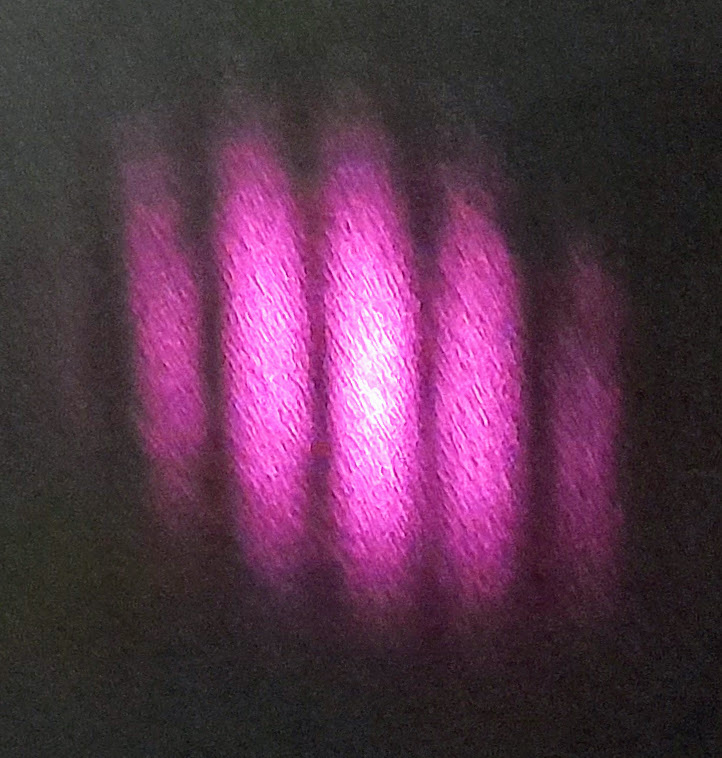
Mach-Zehnder interferometer to demonstrate interference and superposition. In the next iteration, the laser intensity will be strongly reduced so that the average number of photons present in the interferometer is <1 and the screen will be replaced by a photon counter or a single-photon camera. In this case, when a photon is detected, we know that it was alone when it went through the interferometer.
Info
This set-up was built by our undergraduate student (freshman) Leilani Ainsworth.

Quantum Eraser Demo
Description
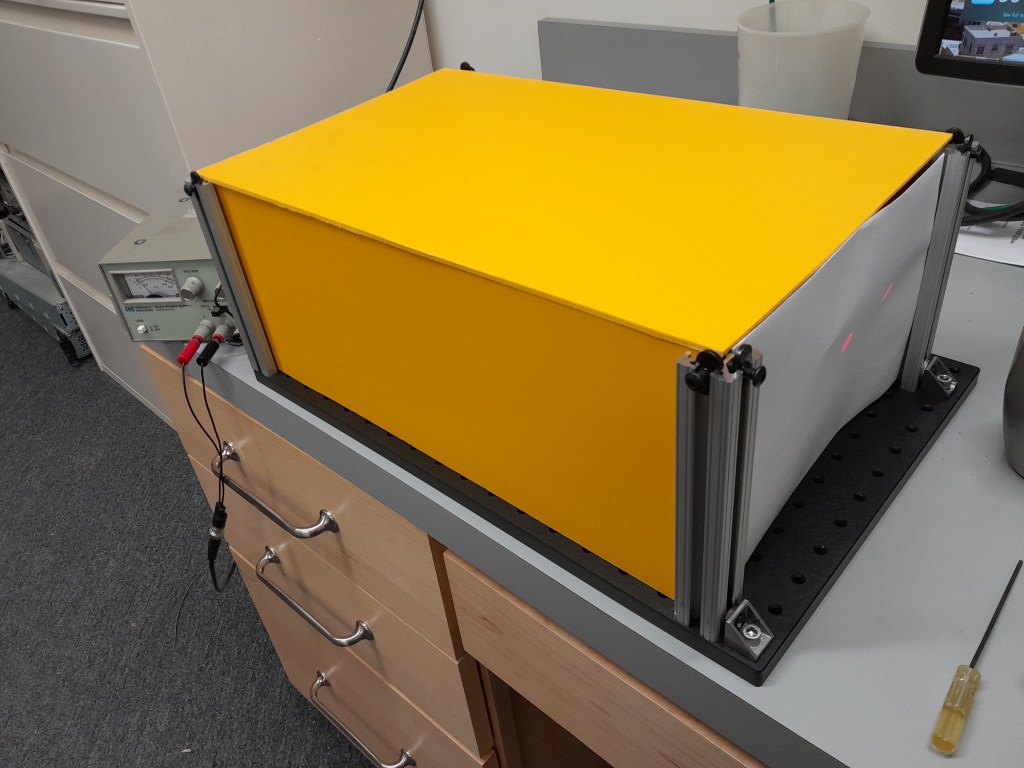
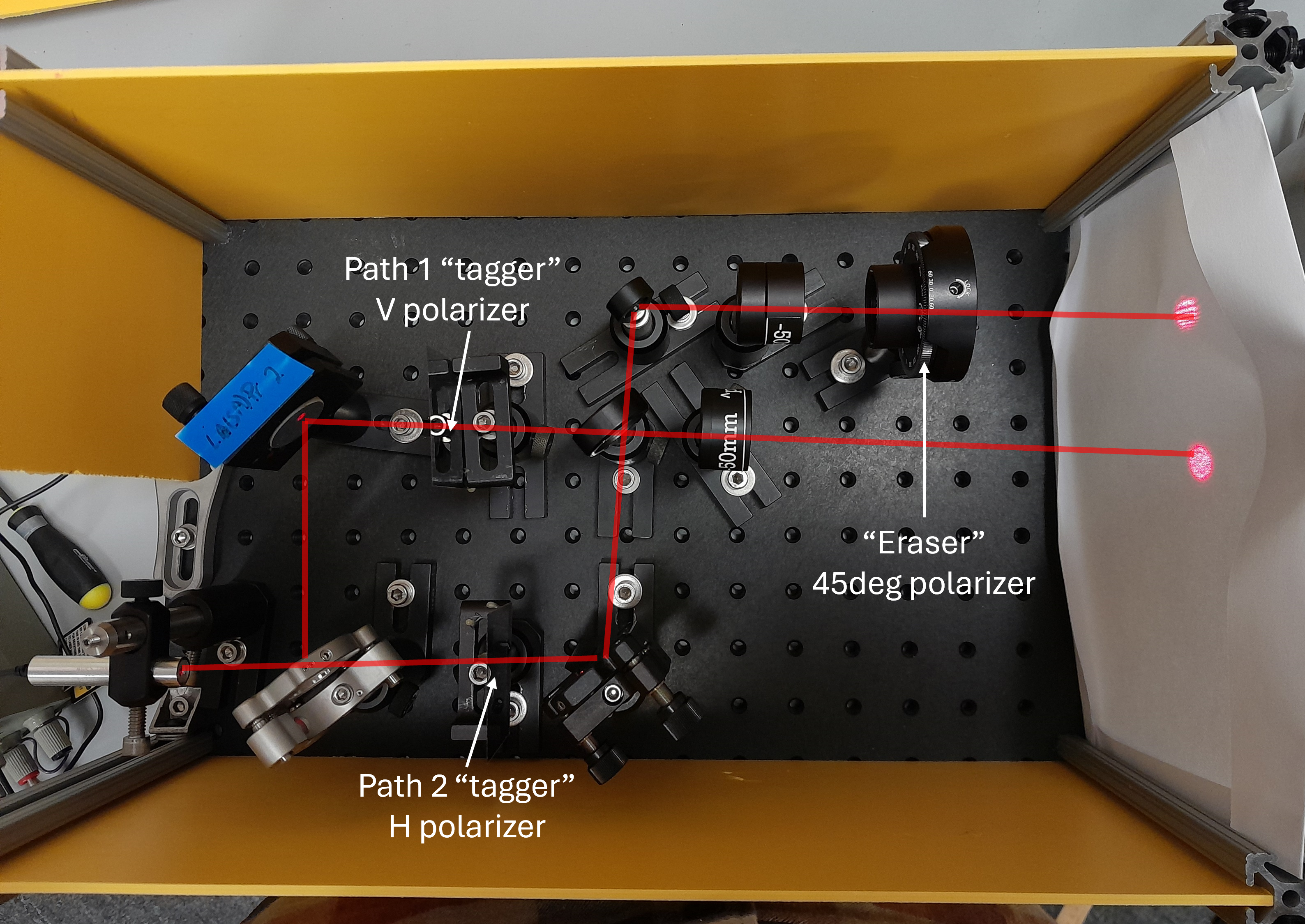
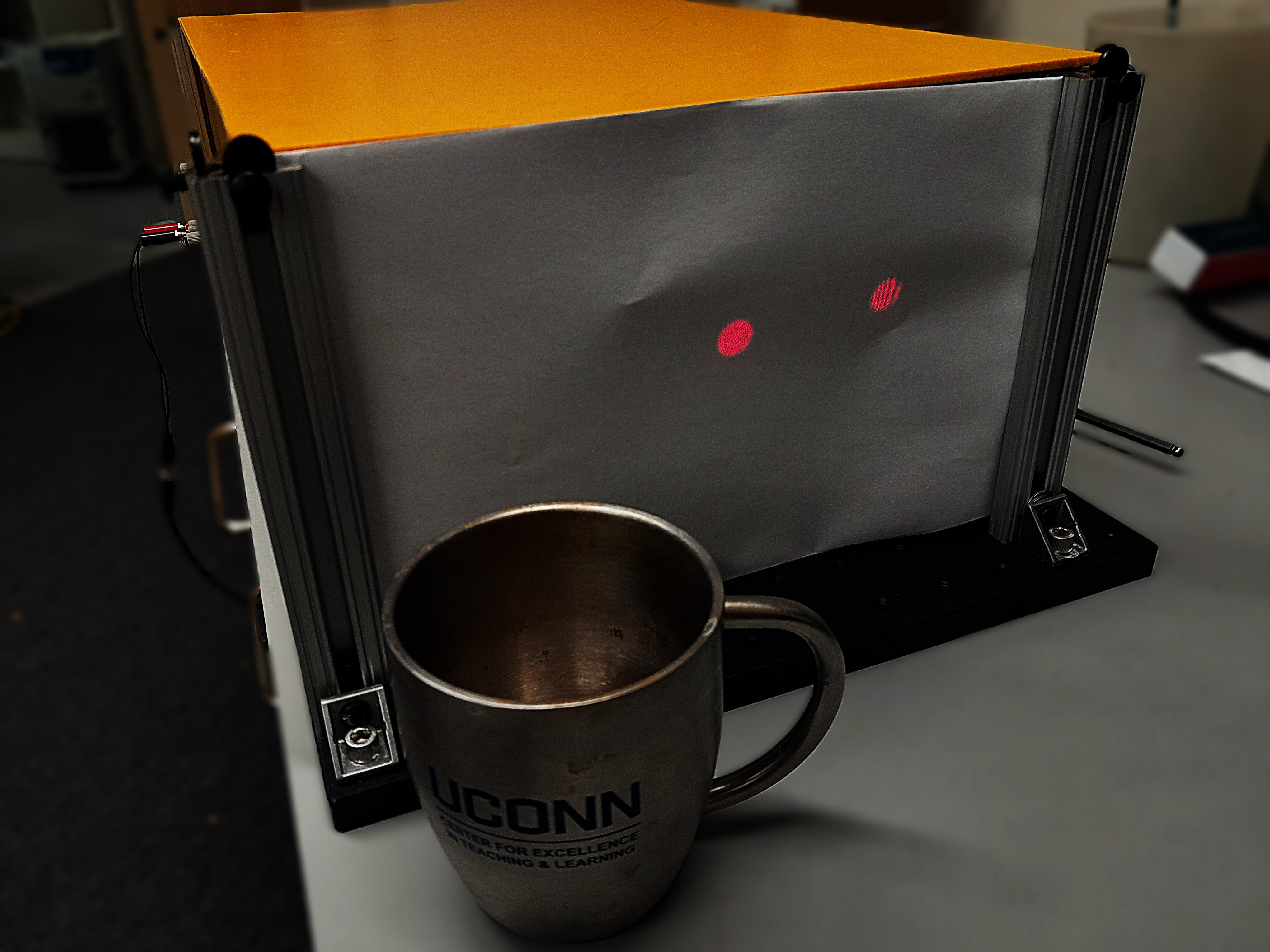
Based on a two-path Mach-Zehnder interferometer. We show that by observing which path a photon takes (i.e., acquiring the which-path information) will destroy the interference pattern. We also show that erasing the which-path information restores the interference pattern!
Outreach events
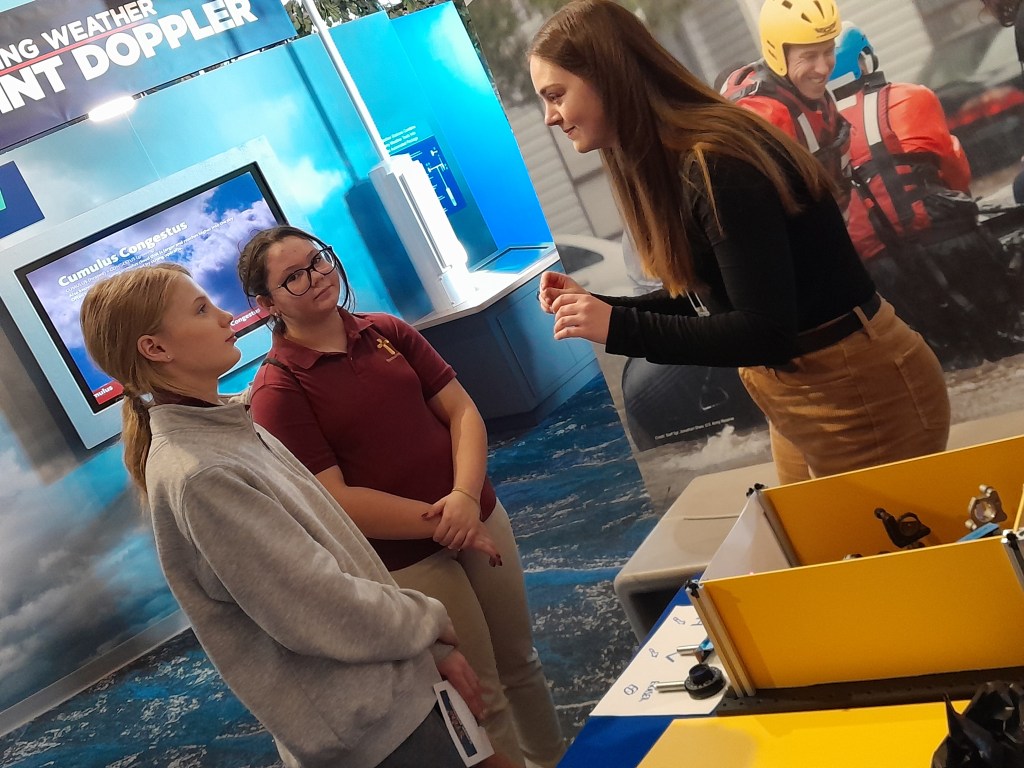
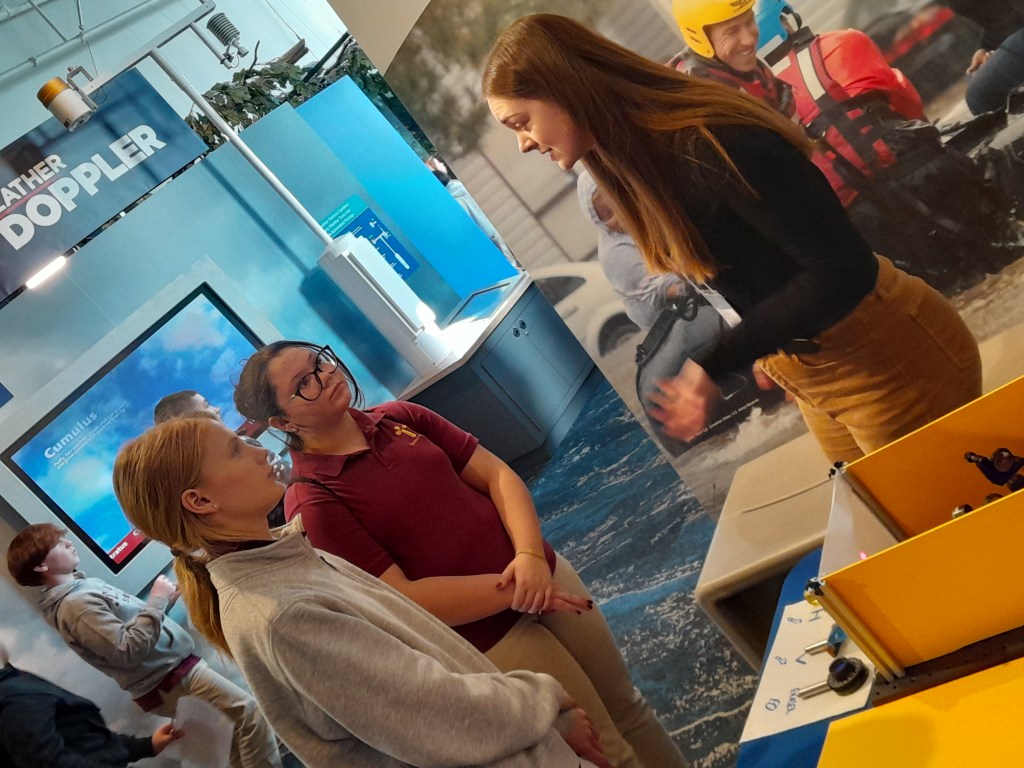
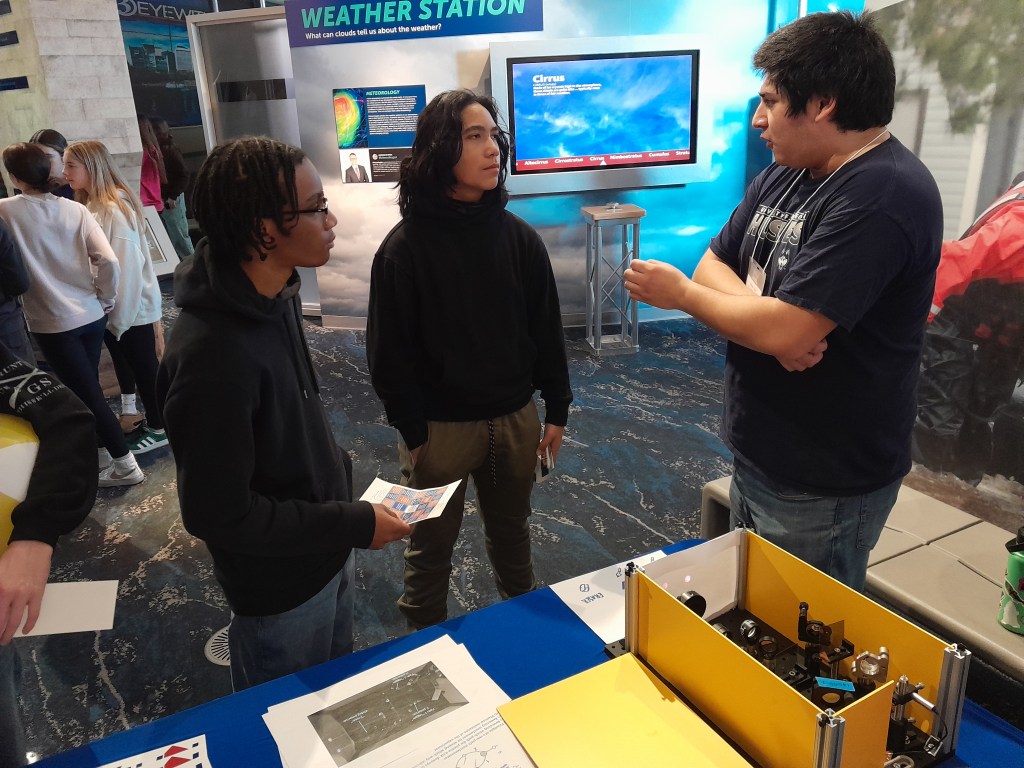
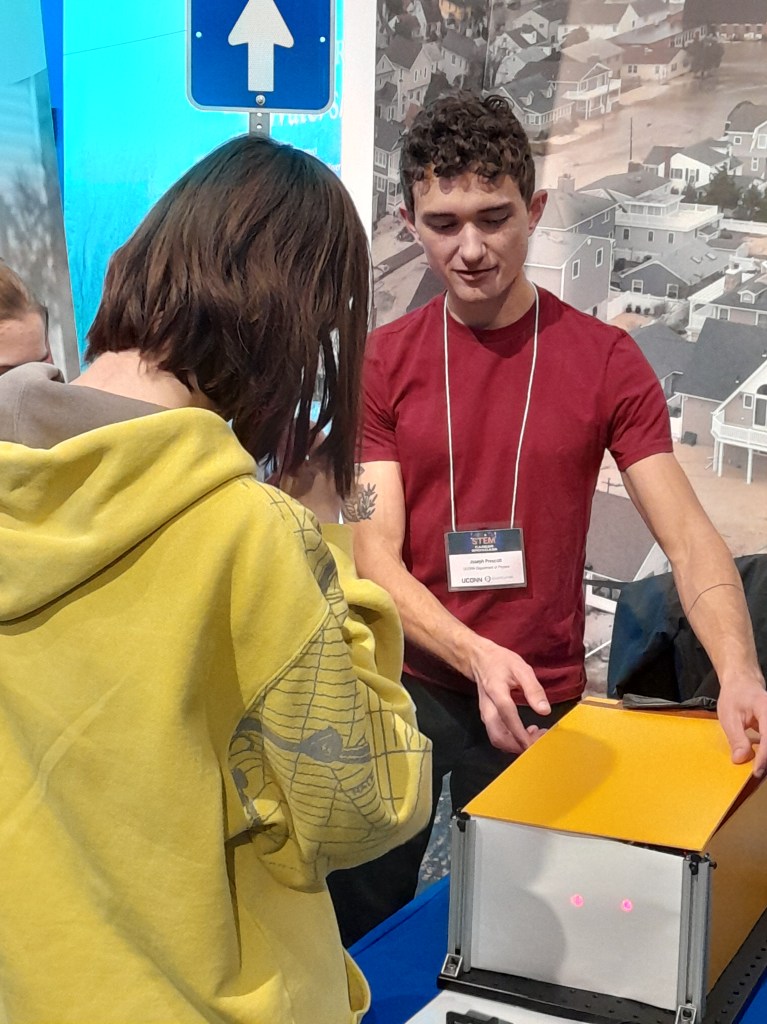
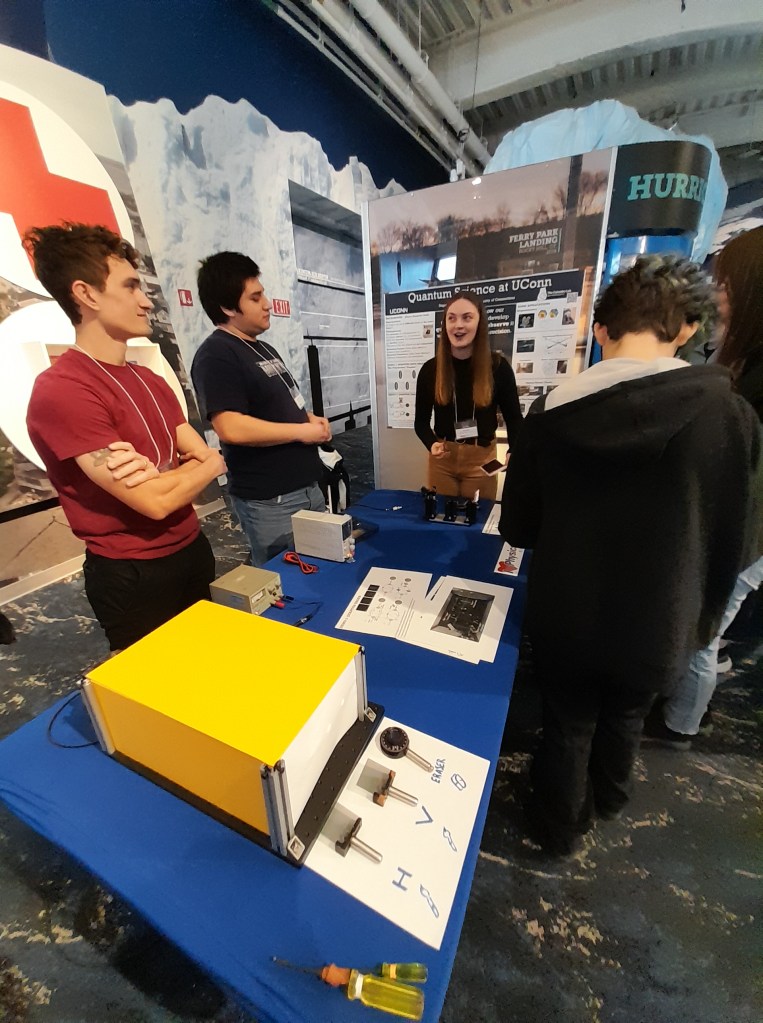
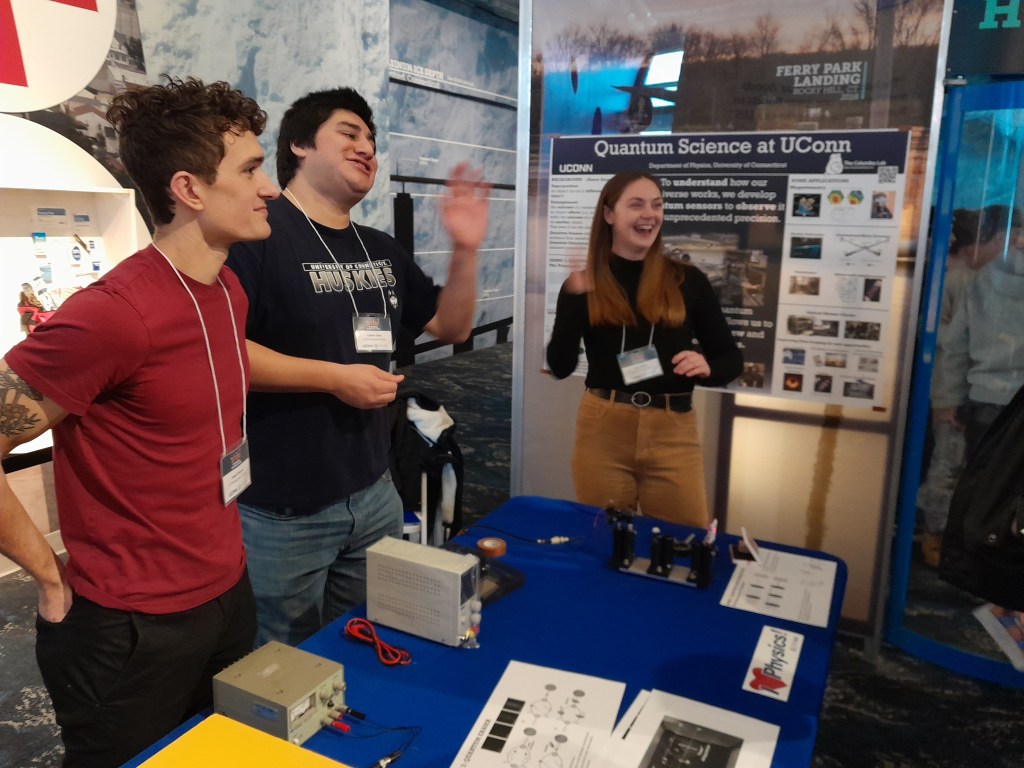
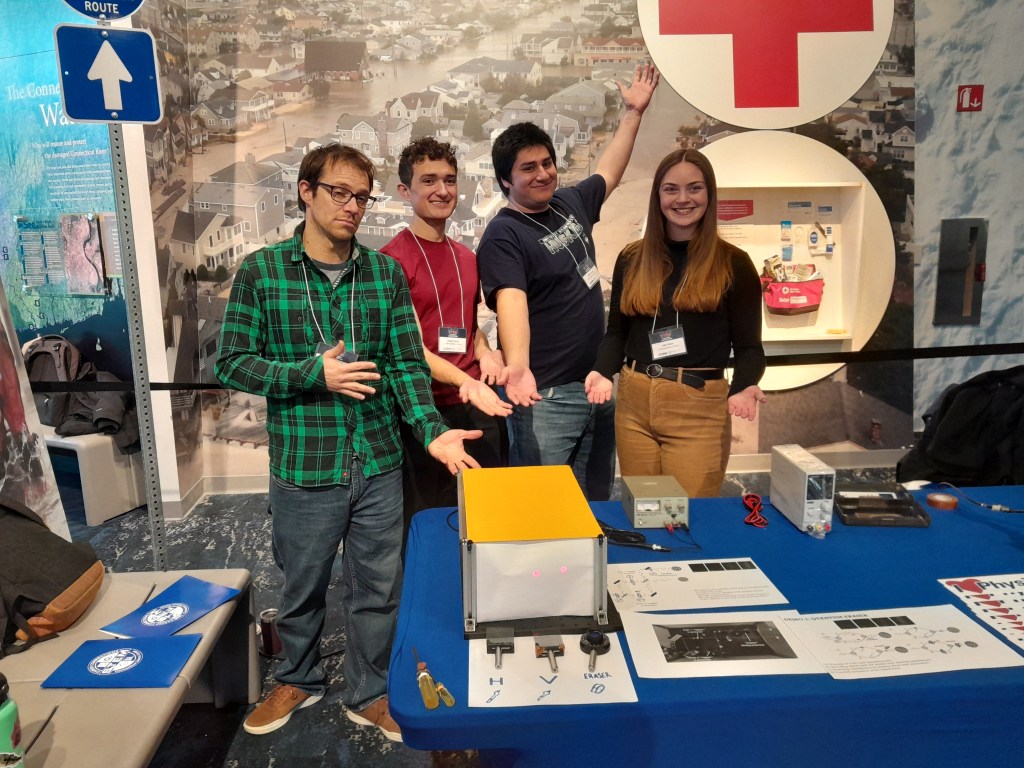
STEM Career Showcase @ CT Science Center, December 3rd, 2024
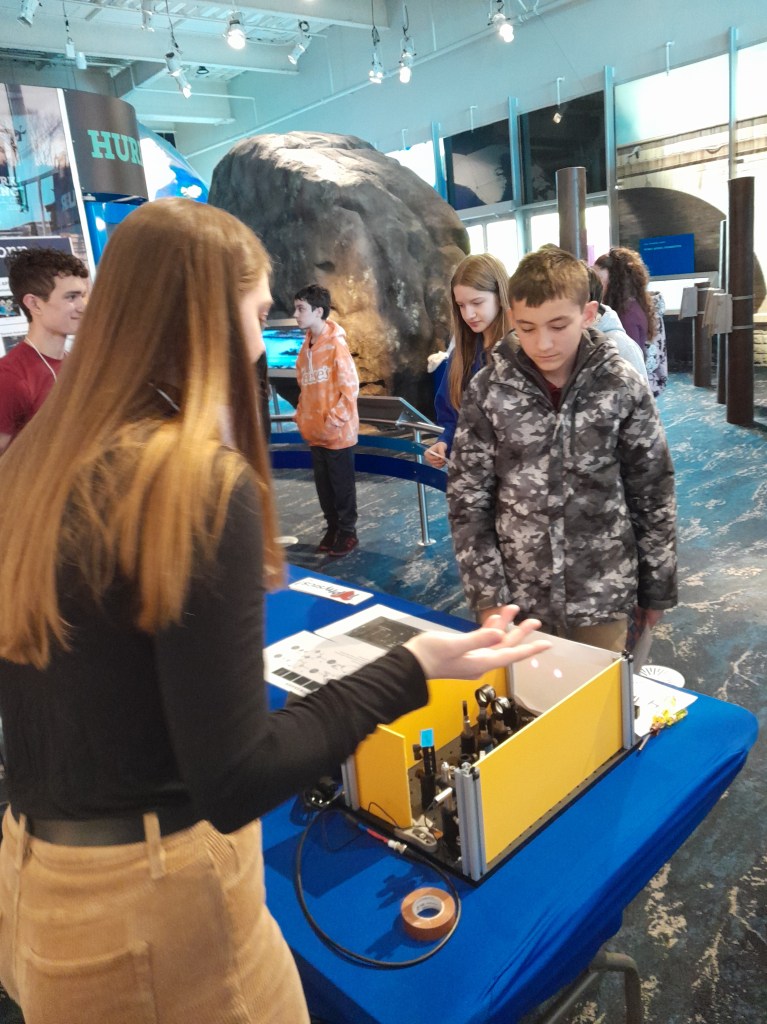
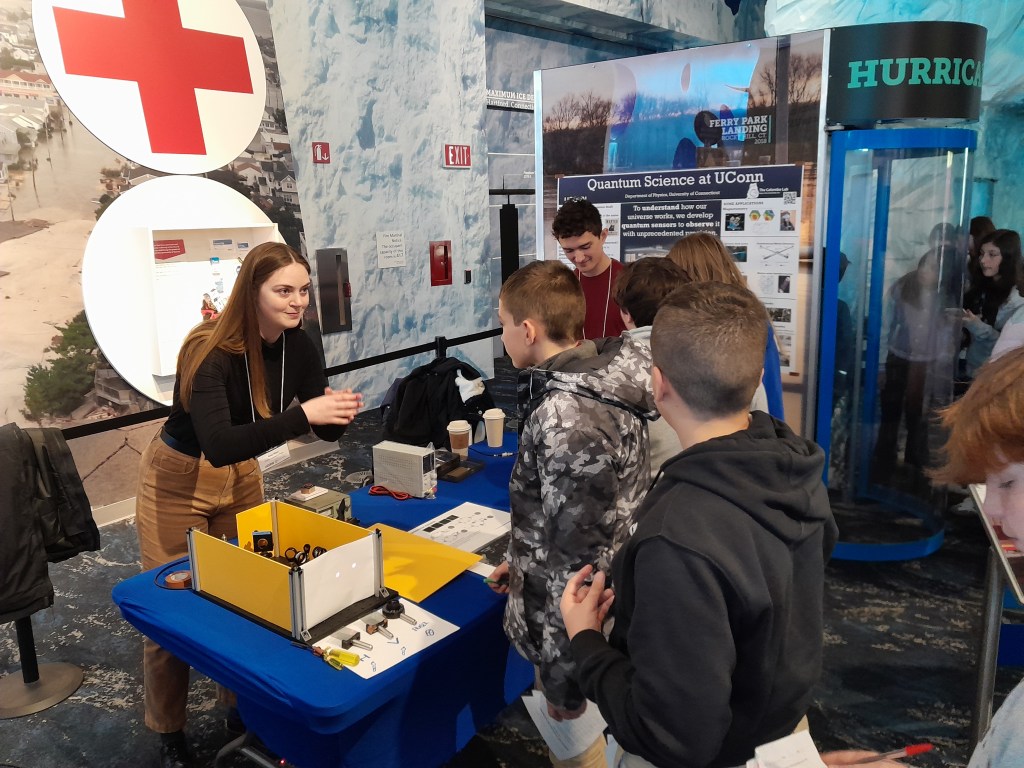
We participated in the STEM career showcase organized by the Connecticut Science Center with a participation of ~1300 middle and high school students from CT and MA!
We brought our two hands-on Quantum Demo:
1) the Polarization “Paradox”, where paradox is in quotation marks as this effect is scientifically well understood while being counterintuitive at a the first sight.
2) A Quantum Eraser demo in a Mach-Zehnder Interferometer (without individual photon resolution yet…).


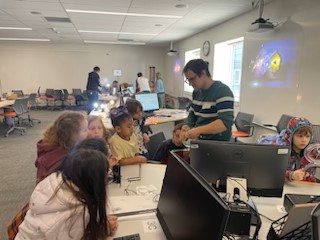
2nd graders field trip, Spring 2024
2nd graders from Mansifield school system visited the UConn Physics Department and they explored, hands-on, various fields of physics.
 The Colombo Lab